The MGA With An Attitude
CHANGING TO A SINGLE 12 VOLT BATTERY - ET-203
At 04:14 PM 10/1/03 -0400, Dick Masse wrote:
>"What to do about battery/ies - the frame is new for the 6V batteries but I was hoping I could get a 12V and put it in the existing frame...any thoughts on that?"
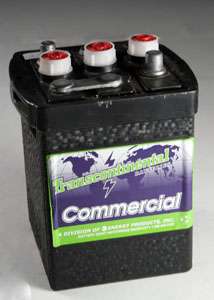
Yeah. The 6V batteries sort of suck, to put it mildly. At least half again the cost of 12V, and you need two. They are also mostly old technology type with only moderate cranking power, and have a life expectancy of about 4 years. For more information on original 6-volt batteries, seee article ET_128. A single 12V will be about 1/3 the price of two 6's, have way more cold cranking power, will probably last about 6 years, and can be bought with a 72 month prorated warranty, possibly for about $49.99 (discount department store).
The smallest commonly available 12V will not fit in the stock 6V carrier. You need to extend one battery carrier (usually the right side) about 1-1/2" at the back edge (a little cut and weld). [This is more recently changed, see bottom of page].
At 05:21 PM 10/3/03 -0400, Dick Masse wrote:
>"I'm adapting the battery box to take a larger battery and it will measure 7.25 x 8.25 x 8. I hope and have a battery selected to fit in there"
No-go. The original battery tray is not that long. If you extend the battery tray, allow an additional 1/4-inch at each end for the rubber pads.
Find battery size numbers here: www.jegs.com/Sizecharts/bcigroup.html
 The smallest standard format 6-volt battery listed there is group 17HF (6V near bottom of list). This one is 6-7/8" wide (sometimes 6-3/4") x 7-3/8" long and 9" tall. It is smaller at the bottom, not more than 6-1/2" the narrow way. It is a direct replacement for the original battery in the MGA. The carrier is barely 6-3/4 wide (maybe 1/16" more) x 7" long (front to back), and that includes space for 1/4" thick L-shape rubber pads at both ends. So the original battery was also about 6-1/2 wide at the bottom. The original Lucas battery number was SG9E (wet as installed), or STGZ9E (dry charged for export).
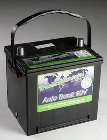
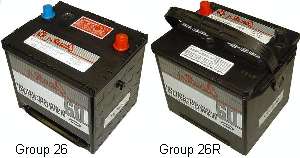
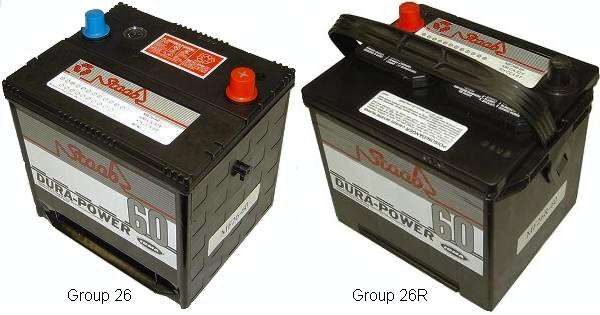
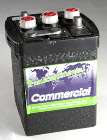
The smallest current commonly available 12 volt battery is the group 26, which is 6-13/16" wide x 8-3/16" long (7-3/4" tall including the posts). This will be very close to 8" long on the bottom, so the original carrier in the MGA needs to be lengthened about 1-1/2" to accept the battery and the rubber pads. Picture on the left shows a battery with the connector posts on the center line, so it is physically reversible. Many 12-volt batteries will have the posts in the corners on the same side of the battery. The group 26R is reverse polarity, which is the same as having the posts on the opposite side of the battery. The red cap is the positive post in this picture.
Bear in mind that the standard group size dimensions include the larger crown size at the top, and almost all of them are slightly smaller at the bottom with the thin walls. Also beware that new batteries can be had with or without bottom flanges for bolting them down, so be sure to look for one without the bottom flanges. I have (once) cut the bottom flanges off of a battery, but you have to be really careful not to cut through the thin wall of the case.
>"assuming I can get it by the trunk frame, etc..."
No problem. Just tilt it about 45 degrees and it goes right in.
>"it has 625 CCA I assume that is enough to do the job."
No problem. The original batteries were about 300 CCA. Modern replacement 6-volt batteries are usually 360 CCA (not much better than days of old). The reason the cold cranking amps is so low is because they are replacements for deep discharge batteries commonly used in golf carts or for trolling motors. Think of these as "old technology" batteries. Modern automotive batteries have much higher cold cranking amps capability, but should be kept close to full charge at all times. The high cranking capacity batteries do not tolerate deep discharge very well.
About 1 amp per cubic inch of engine displacement is enough in mild weather, so start with 100 amps minimum. But you can de-rate the battery to about 40% of the base current capacity at 0dF, and figure it will take at least 200 amps to crank the engine at that temperature, so that's not much of an excess. At -20dF you can derate the battery to about 25% of what it will do when warm, and triple the power required to crank the engine, and all bets are off for getting it started. When I was driving my MGA in the winter while in college, with two new 6 volt batteries it would (usually) start okay down to about 0dF. At -10dF it seemed to crank at a reasonable speed, but didn't seem to vaporize the fuel very well, so a sniff of ether was sometimes in order. Starting should always be easier with a modern single 12 volt battery.
>"not like you have to run a lot of accessories off of it...ha!"
I only run a lot of small current draw accessories, like a 2 amp rally computer or laptop computer. Battery powered tire pump might take 4 to 5 amps for several minutes. Battery powered impact wrench for the lug nuts pulls 10 amps, but only for a few seconds at a time. The biggest power hog I ever installed was a 50 watt stereo radio. That would be about 4 amps cranked up to full volume, so not such a big deal. But if you turn everything on at night, ignition, high beam lights, heater and wipers, it's already getting pretty close to the current capacity of the generator, so one might seriously consider not running the radio much. If you don't need to run the wipers, go ahead and run the radio all night. If you want a beefier radio you will need an alternator conversion.
The one significant disadvantage of the single battery is the total power capacity. If you leave the head lights on and walk away, you would be lucky if it starts two hours later. The two 6 volt batteries make a larger physical package that can carry more plates and hold more total energy. That means it can hold up longer in the event of a generator failure or leaving something turned on. In daylight, if you switch off everything except the ignition (coil and fuel pump), you might drive for several hours on a fully charged battery with no charging. With lights on at night, maybe two hours tops before you can't see anything in the dim glow and the ignition starts to cut out. With two 6 volt batteries with 58-AH storage capacity (as original) you might get an extra hour of running time.
Addendum, December 2009:
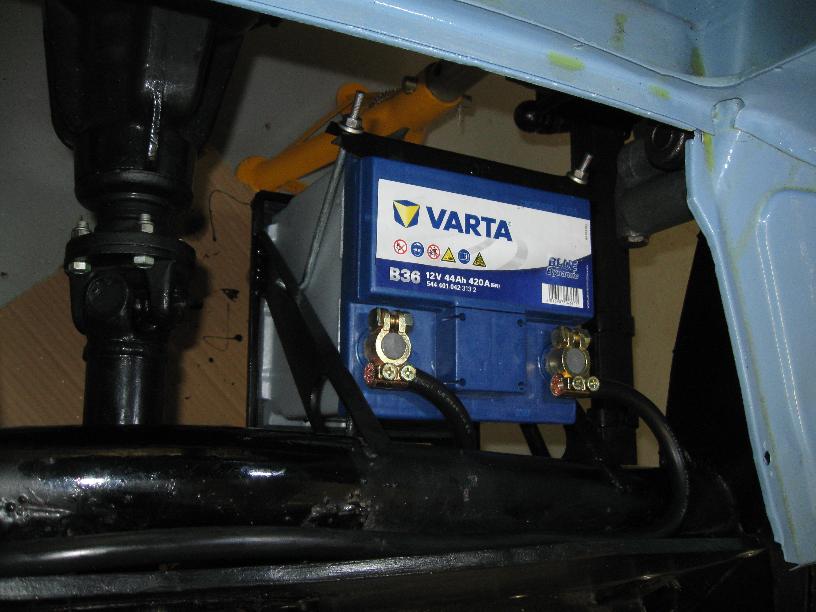
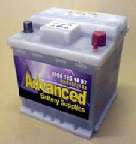
BULLY !!! We finally have a winner on a single 12-volt battery that will fit in the original square battery carrier. These are available in Europe and the eastern hemisphere, so far not found in North or South America (although Varta is now a Johnson Controls company).
Model -- Advanced 002L
Size -- 175mm x 175mm x 190mm Height -- 10 Kg
12 Volt, 40 AH, 360 CCA
Terminal layout: "+" on right
www.advancedbatterysupplies.co.uk
|
|
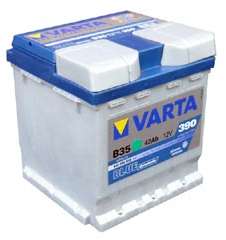
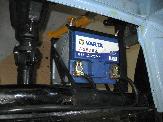
Model -- VARTA BLUE B35
Size -- 175mm x 175mm x 190mm Height -- 11Kg
12 Volt, 42 AH, 390 CCA
Terminal layout: "+" on right
www.advancedbatterysupplies.co.uk
- or -
Model -- VARTA BLUE dynamic B35
Size -- 175mm x 175mm x 190mm Height -- 10.18Kg
Article Number 542 400 039 3132
Case Size: H3 / LN0
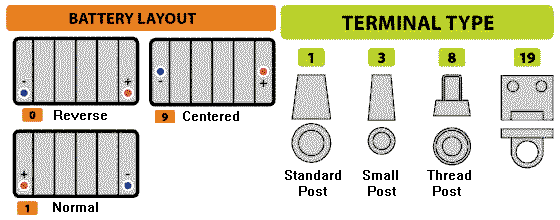
Base Hold-down: B13 - Layout: 0 - Terminal Types: 1
www.varta-automotive.com
- or -
Model -- VARTA BLUE dynamic B36
Size -- 175mm x 175mm x 190mm Height -- 10.18Kg
Article Number 544 401 042
Case Size: H3 / LN0
12 Volt, 44 AH, 420 CCA
www.varta-automotive.com
|

|
Addendum, November 2011:
Now we have more batteries available in the same small size, but as yet still not available in North America.
|
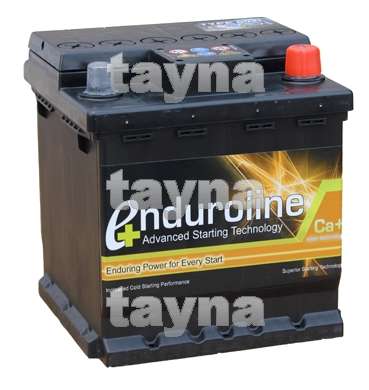
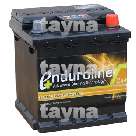
Model -- Enduroline 002L
Size -- 176mm x 175mm x 190mm Height
12 Volt, 42 AH, 395 CCA
Terminal layout: "+" on right
www.tayna.co.uk
|
|
Addendum, January 2012:
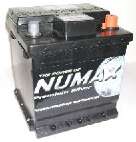
Model -- Numax 002L
Size -- 175mm x 175mm x 190mm Height
12 Volt, 38 AH, 330 CCA
Terminal layout: "+" on right
www.tayna.co.uk
|
|
It just struck me that all of these small 12V batteries are configured with "reverse polarity" favoring positive earth connection in the MGA. For negative earth conversion you would turn the battery around, in which case the main power cable may or may not reach the "+" terminal. I hope your main cable is long enough for the conversion.
On 5/5/2011, Don Canfield in Denmark wrote:
"Thanks for the heads-up on the Varta B35 12V replacement battery. I've just bought one and it fits perfectly into the existing MGA battery cage (although my rubber pads are long gone). Way more cranking power too. You'd faint if I told you the price in Denmark, but it was still half the price of two 6 volt batteries".
On 5/6/2011, Don Canfield wrote:
"If I push the battery all way to one wall, there is slightly less than 1/4 inch clearance to the inner wall of the L member forming the bottom of the cage (actual measurement was about 5 mm). The flange at the bottom of battery is about 1/4 as well, so trimming on this will give some extra clearance if needed".
So the battery does fit in the original tray without the original rubber "L" shape pads. If you want to include the rubber pads you may have to trim most of the plastic flange from two sides of the battery base.
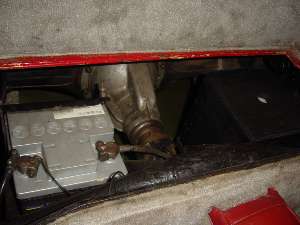
On 17 November 2011, J Bray in Bedford, UK sent this picture of the new Advanced 002L battery installed in his MGA. Do not let the cable drag on the propshaft, and do install a hold-down clamp.
|
|
Addendum, 2/4/1018:
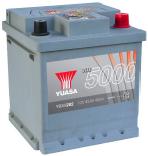
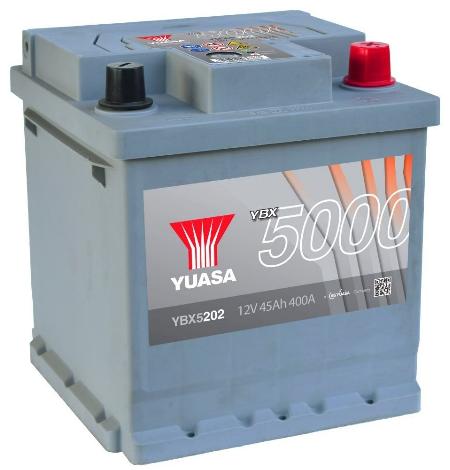
Here's another small one, YUASA YBX5000 series, YBX5202, 12-volt, 45AH, 400 Amps. If you can believe it, that would be very good storage capacity for a battery this small.
|